

Edwin A. Locke, Ph.D.
Introduction
Edwin A. Locke is Dean’s Professor (Emeritus) of Leadership and Motivation at the R.H. Smith School of Business at the University of Maryland, College Park. He received his BA from Harvard in 1960 and his Ph.D. in Industrial Psychology from Cornell University in 1964.
He has published more than 336 chapters, notes and articles in professional journals, on such subjects as work motivation, job satisfaction, incentives, and the philosophy of science. He is also the author, co author, editor or co editor of 13 books, including The Selfish Path to Romance: How to Love with Passion and Reason (Platform Press, 2011), Study Methods and Study Motivation (Ayn Rand Bookstore, 2008), Goal Setting: A Motivational Technique That Works (Prentice Hall, 1984, with G. Latham), A Theory of Goal Setting and Task Performance (Prentice Hall, 1990, with G. Latham), New Developments in Goal Setting and Task Performance, (Routledge, 2013, with G. Latham), Handbook of Principles of Organizational Behavior (Blackwell, 2000; 2nd edition, Wiley, 2009, 3rd edition with Craig Pearce, Wiley, 2023 ), The Prime Movers: Traits of the Great Wealth Creators (Second Edition, Ayn Rand Bookstore, 2008), Postmodernism and Management: Pros, Cons and the Alternative (JAI: Elsevier, 2003), and The Illusion of Determinism: Why Free Will is Real and Causal (2018) .
He is internationally known for his research on goal setting. A recent survey found that Locke’s goal setting theory (developed with G. Latham) was ranked #1 in importance among 73 management theories. His work has been supported by numerous research grants, and he has served as consultant to research firms and private businesses.
Dr, Locke has been consulting editor for numerous professional journals. He was a winner of the Outstanding Teacher-Scholar Award at the University of Maryland, the Distinguished Scientific Contribution Award of the Society for Industrial and Organizational Psychology, the Career Contribution Award from the Academy of Management (Human Resource Division), the Lifetime Achievement Award from the Academy of Management (Organizational Behavior Division), and the James McKeen Cattell Fellow Award from the American Psychological Society. He is interested in the application of the philosophy of Objectivism to behavioral sciences.
View or download Dr. Locke’s Vita PDF | Microsoft Word | HTML
These books are available through Amazon books

The Illusion of Determinism: Why Free Will is Real and Causal
(2018) Many neuroscientists, psychologists and philosophers have argued that the belief in free will is a delusion based on “folk psychology” meaning: naïve beliefs held by ignoramuses. This book will show that the truth is just the opposite: that free will is real and that it is determinism, the doctrine that we have no choice about what we believe, feel or do that is wrong. I show why free will is self-caused, what it consists of (and does not consist of), why determinism is self-contradictory, and why famous experiments which claim to prove determinism prove no such thing. The arguments are not based on religion.
Table of Contents
- The Brain
- Consciousness
- Causality
- Goal-Directed Action
- The Self
- The Libet Studies: Much Ado about almost Nothing
- The Fatal Flaw in Determinism
- What free Will Is– and Is Not
- Conclusion
Approx. 130 pages

New Developments in Goal Setting and Task Performance
Routledge Academic
This book concentrates on the last twenty years of research in the area of goal setting and performance at work. The editors and contributors believe goals affect action, and this volume will have a lineup of international contributors who look at the recent theories and implications in this area for IO psychologists and human resource management academics and graduate students.
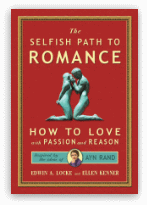
The Selfish Path to Romance: How to Love with Passion and Reason
Platform Press/Winans Kuenstler Publishing
Psychologists Edwin A. Locke and Ellen Kenner offer this thought-provoking and objective guide to finding and nurturing romantic relationships. In this unique look at how we love, you’ll learn that:
- Altruism (self-sacrifice) destroys romance
- Love is not mysterious but understandable
- Love and reason are fully compatible
- Love must be earned, and how to earn it
- Romantic love must be sustained by active thinking
- Conflict is inevitable yet often resolvable
Table of Contents
Preface
About the Authors
Acknowledgments
About Ayn Rand
Introduction
Part I: The Basics
Chapter 1: What Is Romantic Love?
Chapter 2: Altruism and Narcissism: Two Approaches to Love That Do Not Work
Chapter 3: True Romantic Love Is Egoistic
Chapter 4: Understanding Love
Part II: Making Yourself Lovable
Chapter 5: Building Moral Character
Chapter 6: Developing Genuine Self-Esteem
Chapter 7: Values, Appearance, Communication
Part III: Finding Your Soul Mate
Chapter 8: Achieving Harmony Between Reason and Emotion
Chapter 9: Choosing the Right Partner I
Chapter 10: Choosing the Right Partner II
Chapter 11: Choosing the Right Partner III
Part IV: Making Your Romantic Relationship Thrive
Chapter 12: How to Cherish Your Parter I
Chapter 13: How to Cherish Your Parter II
Chapter 14: How to Cherish Your Parter III
Chapter 15: Creating a Positive Emotional Climate
Chapter 16: Love Destroyers and How to Fix Them
Part V: Enjoying Sex
Chapter 17: Understanding What Sex Is and Why It’s Good
Chapter 18: Creating Intimacy and Mood
Chapter 19: Technique, Afterplay and Feedback
Chapter 20: Prioritizing Sex and Overcoming Subverters of Sexual Pleasure
Part VI: Resolving Conflict
Chapter 21: Causes of Conflict I
Chapter 22: Causes of Conflict II
Chapter 23: Communication Methods That Do Not Work
Chapter 24: Communication Methods That Work
Chapter 25: Compromise and Dealing with Your Partner’s Resistance
Epilogue
Appendix: How to Part Ways and Start Over If You Cease Being Soul Mates
For more information, visit www.selfishromance.com
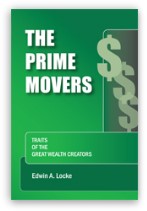
The Prime Movers: Traits of the Great Wealth Creators
Updated Second Edition
What enables the “Prime Movers”—businessmen like Andrew Carnegie, James Hill, Bill Gates—to create wealth on such a vast scale?
To answer this question, Dr. Locke identifies the essential psychological traits of these and other great businessmen from the 19th and 20th centuries. In this book, he notes, “we can see efficacious people at work, people who use their own independent judgment and who—through passion, tenacity, and ability—succeed against all odds.”
Rather than offering an unintegrated series of biographical sketches, The Prime Movers is organized thematically. Chapter headings focus on particular characteristics: independent vision; an active mind; competence and confidence; drive to action; egoistic passion; love of ability in others.
A recurring cast of successful businessmen serves to illustrate these traits. We learn about innovators like Michael Dell, who envisioned the idea of low-cost, high-quality computers marketed directly to consumers. It was Walt Disney’s passion for animation, writes Locke, that drove him to work 20-hour days. Pierre DuPont prized human ability so highly that he bought up other companies solely to acquire their talented employees.
The Prime Movers is not only an examination of the psychological traits of great businessmen, but a moral defense of wealth creation. It points out that many of these Prime Movers (implicitly) embrace the virtues of rationality, productiveness, honesty, egoism and integrity. Rejecting the ubiquitous claims of their denouncers, Dr. Locke argues that these prodigious wealth-creators are not exploitative “fat-cats” who get rich at someone else’s expense; on the contrary, they are men of virtue—if the term is properly understood. They are, he writes, “neither blind emotionalists nor emotionless rationalists. They are passionate lovers of their work and of success, who use reason to guide their choices and actions.” (Dr. Leonard Peikoff’s speech “Why Businessmen Need Philosophy” is included as an appendix to this book.)
This book, which draws on a number of Dr. Locke’s lectures, is full of heroic personalities and valuable guidance. Whether you are curious about “How to Make a Billion Dollars” (as one chapter title puts it), or are a hero-worshipper who admires giants of human ability, this book is an inspiring read.
Praise for The Prime Movers
The Prime Movers gives us a wonderful philosophy of living and being successful in the business world. More than a book about business, it is also about treating people honestly and fairly in an ethical environment. If you study Dr. Locke’s seven traits of the great wealth creators, you may not become a billionaire, but I promise that you will be a better manager, a better business leader, and a better person.
— F. Kenneth Iverson, Chairman Emeritus, Nucor Corporation
Dr. Locke’s survey is as unique as the subjects he studies. Guided by an objective standard for gauging productive prowess, he identifies a handful of the most crucial personality traits held in common by history’s greatest business creators and leaders. We learn what’s never yet been taught about the productive giants of yesterday and today. Better still, we’re given a reality-based, time-tested, and objective yardstick for identifying the giants of tomorrow. This books deserves the rapt attention of entrepreneurs, business leaders, board members, venture capital firms, executive recruiters, and business students.
— Richard M. Salsman, President, InterMarket Forecasting, Inc.
Finally, someone has identified what it truly takes to become a Sam Walton, Mary Kay Ash, or Bill Gates. Edwin Locke inductively builds his case for the seven core traits of such Prime Movers, and pulls no punches along the way. Want to know how to become a billionaire? Study this book and see if you have the right stuff.
— Tom Becker, Ph.D., Associate Professor of Management, University of Delaware
Edwin A. Locke, an internationally known scholar in the behavioral sciences, has applied his extensive knowledge of philosophy, psychology, and business history to explain what makes great wealth creation possible. Especially interesting to me was his observation that love of one’s work and the setting of specific, high goals firmly grounded in reality were key factors in enabling individuals to become Prime Movers in the world of business. An extraordinary piece of work that should be read by every person in the field of business.
— Gary P. Latham, Secretary of State Professor of Organizational Effectiveness, Rotman School of Management, University of Toronto
Table of Contents
Foreword
Preface
Chapter 1: The Creation of Wealth
Reason; Rights; Technology; The Relationship between Freedom and Wealth; Economic and Political Freedom; Prime Movers; The Traits; Conclusion
Chapter 2: Independent Vision
What Is Vision? Myopic Visions; The Danger of Experts; Visions as Evolutionary; Vision Communication; Independent Visions; Visionaries and Their Companies; Conclusion
Chapter 3: An Active Mind
Thinking; Volition; Reality; Intuition; Active Minds at Work; How Do Active Minds Go “Bad”? Conclusion
Chapter 4: Competence and Confidence
Competence and Learning; Confidence; Prime Abilities; Risk; Reaching Beyond One’s Grasp; Overconfidence; Fear of Failure; Conclusion
Chapter 5: The Drive to Action
Action; Prime Movers in Action; Actions Off Course; Drive; When Is Enough, Enough? Conclusion
Chapter 6: Egoistic Passion
Counterfeit Egoism; True (Rational) Egoism; Prime Movers at Work; Egoism and “The Public Interest”; The Prime Mover’s Attitude toward Himself; Passion and Reason; Conclusion
Chapter 7: Love of Ability in Others
Business and Friendship; Prime Movers as Ability Lovers; Falls from Grace; The Role of the Individual in an Age of Groupism; Conclusion
Chapter 8: Virtue
Values; Egoism; Rationality; Independence; Productiveness; Honesty; Integrity; Justice; Virtues as Guiding Corporate Principles: BB&T; The Evil of Initiating Force; Conclusion
Chapter 9: How to Make a Billion Dollars
Other Traits; Male and Female; Strategy; Management; The Success Quartet; Business and Religion; Giving Back; Antitrust; Inequality; Greed; Hatred of the Good
Appendix A. Amounts of Wealth Created by (Selected) Prime Movers Mentioned in This Book
Appendix B. “Why Businessmen Need Philosophy” by Leonard Peikoff
Index of Company Names, Subjects, and Terms
Index of Names
Excerpts
. . . earning money (as contrasted to taking or stealing money, or getting it through government favors or handouts) is a spiritual achievement. By spiritual, I mean that money is earned through virtue — the cardinal virtue being the relentless use of one’s rational faculty.
Many business disasters have occurred because someone did not want to see reality as it was. . . .
. . . I believe the real key to the wealth creator’s motivation is, surprisingly, love — not selfless love for others, but a profoundly personal, selfish love of the work. . . .
Stakeholder capitalism is nothing more than an attempt by some people to plant their stakes on other people’s property.
. . . I do not know a single case in which a businessman created wealth through the consistent utilization of these religious principles [praying for miracles, faith as a means of knowledge, and self-sacrifice] in his business affairs.
The proper principle, which Prime Movers should assert proudly, is: I earned my wealth through my own honest efforts; therefore, it belongs to me by right. . . .
Antitrust law is nothing more than the attempt to crush creative capacity of great wealth creators through coercion.

Study Methods & Motivation: A Practical Guide to Effective Study
Third Edition
An unusually helpful tool for the serious student, this book offers a concrete program for improving study skills by isolating the two fundamentals of successful studying: proper thinking methods and proper motivation.
The principles rigorously detailed are applicable to any educational endeavor—including the world of work. This is an invaluable aid for students and anyone whose life involves studying and learning.
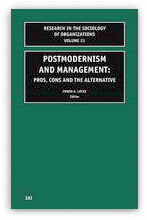
Postmodernism and Management: Pros, Cons and the Alternative
Research in the Sociology of Organizations, Volume 21
JAI: Elsevier
This book contains four chapters by four leading pro-postmodernists, four chapters by anti-postmodernists including an important chapter showing that Immanuel Kant is the source of postmodern thought and identifying the fatal flaw in Kant’s epistemology. The book ends with a chapter showing that Ayn Rand’s philosophy of Objectivism is the proper antidote to postmodernist skepticism and nihilism.
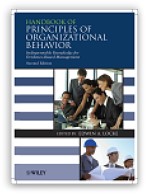
Handbook of Principles of Organizational Behavior Second Edition
Wiley
This book is based on Ayn Rand’s theory of epistemology, specifically her concept of thinking in principles. The book includes contributions from the foremost experts in the various sub-fields of organizational behavior. Each chapter identifies, explains and gives examples from practice of a core principle associated with effective management.
This edition includes an introduction about the need to think in principles and a chapter on emotions by Dr. Locke. Indispensable knowledge for evidence-based management.
Get in touch!
Email Dr. Locke

Use this form to email Edwin A. Locke.
Response times vary, but often occur within 48 hours.
Get in touch!
Use this form to email Dr. Locke